
13 August 2025
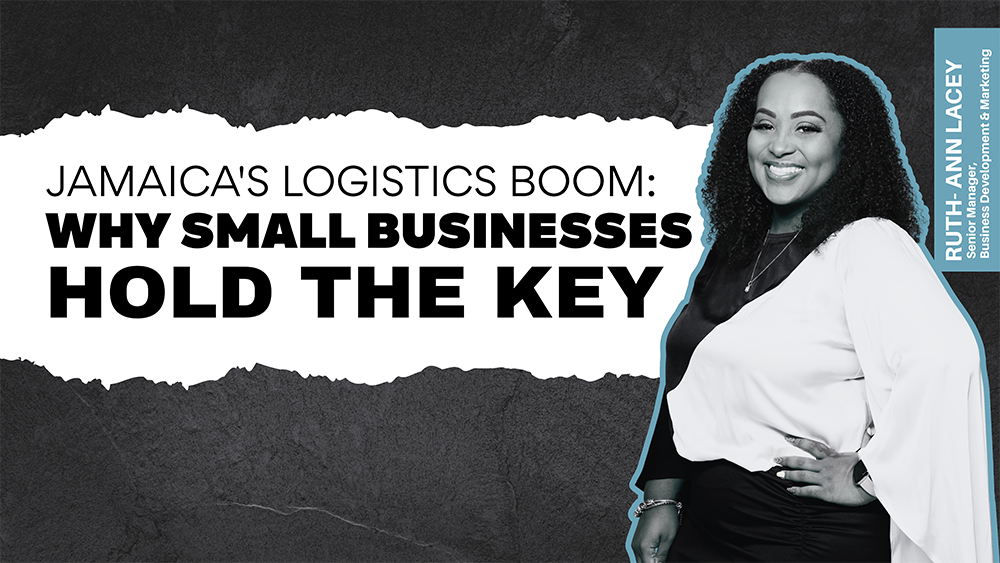
Jamaica’s Logistics Boom: Why Small Businesses Hold the Key
The concrete towers of New Kingston tell only a part of Jamaica’s economic story. Behind the gleaming facades lies a fundamental truth: our economy’s resilience depends on the thousands of micro, small, and medium enterprises (MSMEs) that form the backbone of our logistics and warehousing sector and represents approximately 80% of jobs in the island. As Caribbean trade transforms, Jamaica must urgently rethink how we plan our cities and develop real estate to support these crucial businesses.
The Urban Planning Challenge
The unfortunate reality is that Jamaica’s urban planning has long favoured large-scale developments while inadvertently marginalizing the businesses that drive our economic engine. Our zoning laws and regulatory and development processes create barriers for MSMEs seeking logistics operations, pushing small operations to a periphery of converted residential properties, inadequate spaces, or expensive month-to-month rentals preventing long-term planning, thereby increasing costs and reducing competitiveness.
Consider areas like Naggo Head, St. Catherine and Spanish Town Road, St. Andrew, which house numerous MSME yet lack integrated planning. Poor road connectivity, inadequate public utilities, and limited digital infrastructure force these businesses to operate below potential. Meanwhile, prime logistics locations remain dominated by large local, international and multi-national players who can afford premium costs.
Smart urban planning would recognize that MSMEs need different spatial solutions: flexible, affordable spaces that adapt to changing needs, proximity to transportation networks, and clustering opportunities for resource sharing. Instead of mono-functional industrial zones, urban planners and real estate developers should focus on the creation of mixed-use logistics districts integrating MSME operations with supporting services.
The Real Estate Gap
MSMEs require modular warehouse spaces of 2,000 to 20,000 square feet, flexible lease terms, and integrated office-warehouse configurations supporting lean operations. They need adequate commercial vehicle parking, loading dock access, and room to grow.
Innovative developers could create significant value through MSME-focused logistics parks featuring smaller units, shared amenities like security and maintenance, and flexible zoning allowing commercial, light industrial and manufacturing, storage and distribution. The key is achieving economies of scale through shared infrastructure while maintaining required flexibility.
The Economic Multiplier Effect
Supporting MSME logistics extends far beyond individual businesses. These companies connect rural producers to urban markets, facilitate goods distribution across the island, and provide employment in overlooked communities. Strengthening MSME logistics capabilities enhances our entire economy’s efficiency and resilience.
A Vision for Integration
The path forward requires fundamental shifts in urban planning and real estate development. We need integrated logistics districts combining MSME-focused warehousing with supporting services, and transportation infrastructure connecting ports, airports, and highways. These districts must be designed for flexibility, allowing businesses to adapt as conditions change.
Government policy must evolve through reformed zoning laws enabling mixed-use logistics developments, infrastructure investments benefiting MSMEs, and incentives encouraging developers to build MSME-focused facilities. This includes streamlining permits and reducing regulatory barriers disproportionately impacting smaller businesses.
Conclusion
Jamaica’s logistics sector faces a critical juncture and Jamaica’s economic future depends on creating environments where MSMEs thrive, particularly in logistics and warehousing. This requires coordinated efforts between planners, developers, policymakers, and business communities to rethink city design and commercial space development. This requires more solutions such as Kingston Gateway by private developers and the reigniting of the Garmex Industrial Park by the Government of Jamaica, to be not the exception – but the continued reality.
The question isn’t whether MSMEs will continue playing crucial roles – they undoubtedly will. The question is whether we will create conditions for their full potential or treat them as development afterthoughts. Our choice determines not just individual business success, but Jamaica’s entire economic resilience and competitiveness.
It’s time to build from the ground up, recognizing that our economic towers are only as strong as the MSME foundation supporting them.
Author: Ruth-Ann Lacey
Also See
Proven Properties take over St Ann
Beautiful spaces have the ability to create a kind of tranquillity that’s not only long-lasting but also life-changing. Knowing all too well how imp ... Read More
Real Estate Talk | Essential home décor tips to elevate your space
Imagine waking up to the gentle scent of lavender from your diffuser, birds serenading you as sunlight filters through your windows, and the soothing ... Read More

